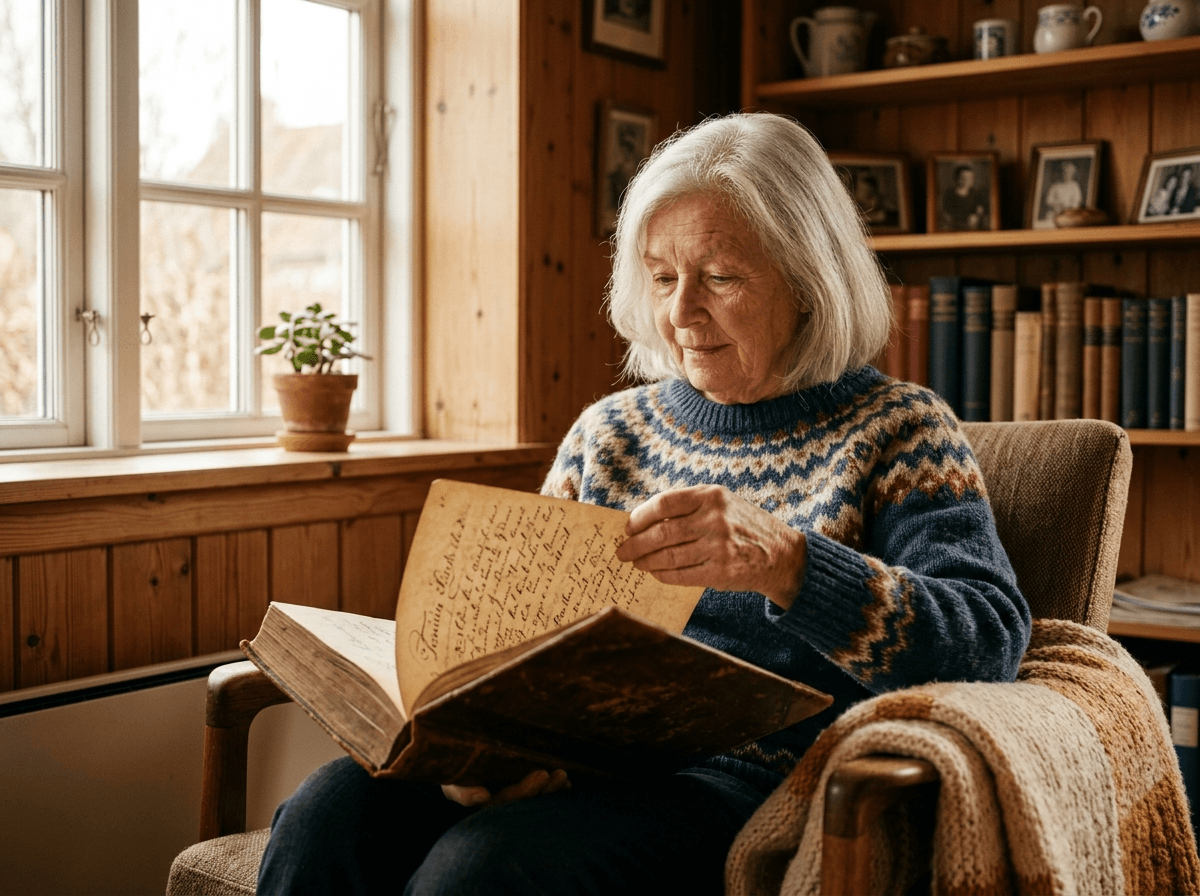
Move forward in your genealogy research
Parish registers, censuses and probate records before 1875 are written in Gothic handwriting that few can read today. Upload a photo and get readable text in just minutes – so you can trace your ancestors further.
Drop a photo of your handwriting here
or click to select — free & no sign-up
Gothic script is the biggest wall in Danish genealogy
Almost everyone hits the same wall sooner or later when researching their family: the sources exist, even digitised on Arkivalieronline – but they are written in Gothic handwriting that has not been taught in Danish schools since the school reform around 1875. Parish registers of baptisms, marriages and burials, censuses from 1787 onwards, deeds, probate records and conscription rolls: the backbone of every family tree lies in documents that most Danes today simply cannot read. It is not a question of language – it is a question of a script that fell into oblivion in just a couple of generations.
Why Gothic handwriting is so hard to read
Gothic handwriting has letterforms that are deceptively similar: an e that looks like an n, a long ſ that can be confused with f and h, and a u distinguished from n only by a small curve. Add to that the old orthography: before the 1948 reform people wrote »Aa« instead of »Å«, and all nouns began with a capital letter. These are not errors – they are the correct spelling of the time, and a good transcription preserves it. Many genealogists spend months learning to read the script themselves. With AI you can skip the learning curve and get the readable text right away.
From an unreadable source to names, dates and places
Once a parish register page or census has been deciphered, it opens up: suddenly there are names of parents and godparents, a birthplace, an occupation, an age. These are the details that take you a generation further back. MormorsBreve is built for exactly this – upload a photo or a scan from Arkivalieronline and get the text in a form you can search, copy and save in your genealogy software. The first pages are free, so you can see the quality before you decide.
What you'll find — and what our AI can read
- Gothic handwriting – standard in parish registers and censuses before 1875
- Transitional script – a mix of Gothic and Latin script around 1875–1900
- Old orthography – »Aa« for »Å« and capitalised nouns before 1948
From old handwriting to readable text
Related articles
Tyd gotisk skrift: guide for begyndere
Lær at tyde gotisk skrift: alfabet, typiske faldgruber og praktiske øvelser. Sådan læser du gamle breve, dagbøger og kirkebøger fra før 1875.
Read articleSlægtsforskning for begyndere: kom godt i gang
Slægtsforskning for begyndere: find dine aner i kirkebøger og folketællinger på Arkivalieronline – og tyd den gotiske skrift, der spærrer vejen.
Read articleGammel dansk retskrivning: Aa, Å og navneord med stort
Forstå gammel dansk retskrivning: hvorfor der står »Aa« i stedet for »Å«, og hvorfor navneord blev skrevet med stort før reformen i 1948.
Read articleLæs kirkebøger og folketællinger: en praktisk guide
Sådan finder og læser du kirkebøger og folketællinger på Arkivalieronline – og tyder den gotiske skrift, der holder dine aner skjult.
Read article